
How to choose your Pickleball paddle?
Choosing a pickleball racket can be difficult. There are hundreds of paddles from which to choose. Your play style will lead you to the type of paddle that makes the most sense for you.
Here is a short guide to help you selecting the right racket for you. Ultimately, the choice of balance depends on the individual player's style of play and preferences.
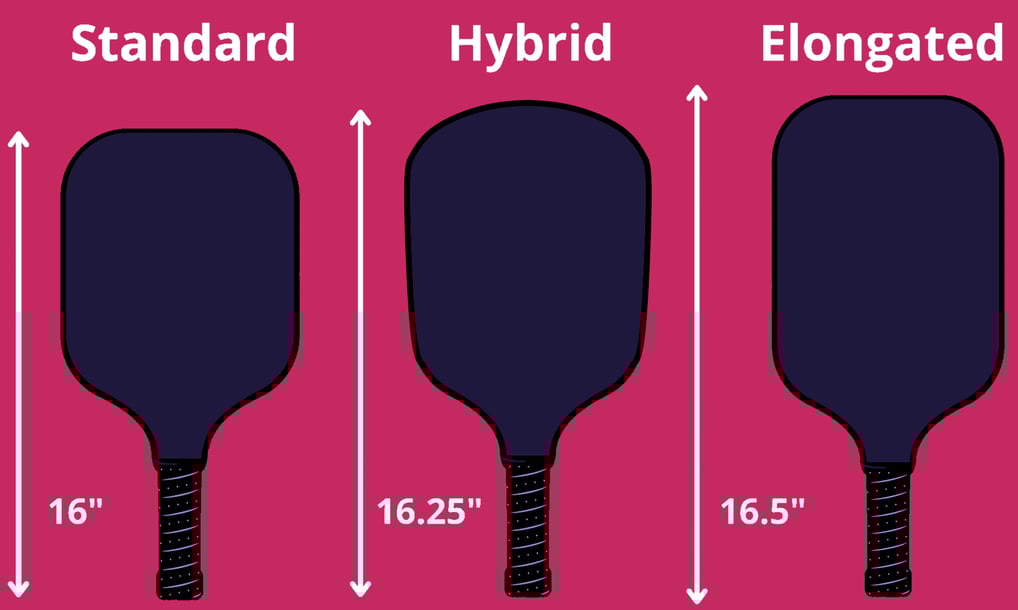


Shape
Pickleball racket shape influences playability in numerous ways. Ultimately, it affects the size, placement and shape of the sweet spot. All manufacturers work within the USA Pickleball specifications for paddle shape:
Size: The combined length and width, including any edge guard and butt cap, shall not exceed 24 inches (60.96 cm). The paddle length cannot exceed 17 inches (43.18 cm). There is no restriction on paddle thickness
In general terms, the longer and narrower a paddle is, the higher the sweet spot will be on the face. A higher the sweet spot means it is further away from your hand (greater leverage), and the contact point on the face is therefore moving faster when it strikes the ball. All of this translates to more power!
Weight
A pickleball racket's weight affects both power and control to a great degree. The heavier a paddle is, the more power it will deliver. The lighter a paddle is, the quicker you can position it for your next shot, yielding an increase in shot control. The secret is to find the weight that works best for you.
The optimal swing weight is therefore different for every player. It is the weight at which you swing a paddle that neither sacrifices hand speed, nor causes over-exertion to generate power.
For most players it is somewhere between 200gr and 240gr; consequently, the best way to determine the right swing weight for you is by testing many paddle weights or experimenting with adding weight (such as lead tape) to your paddle.
Face Material
Face material is important in determining the power and control characteristics of your pickleball paddle. Once again, it determines the amount of energy absorbed or returned to the ball. Because the face is the largest part of the paddle and has the direct contact with the ball, it goes a long way in determining paddle performance. Graphite and Carbon Fiber are harder materials and absorb energy, allowing the ball to dwell on the face slightly longer and providing you a feeling of greater control over your shot placement. Fiberglass, on the other hand, is a softer material, it flexes, and produces a trampoline effect that returns more energy to the ball. This translates to greater power behind your strikes.
Your paddle's face material is also important in enhancing spin. The majority of spin on a ball is generated by the player and the path of their stroke. A paddle accentuates spin one of two ways – friction or adhesion. The coarser a paddle face is, the more friction it generates. Adhesion occurs when a paddle face is smooth but tacky. This causes the paddle to “grab” the ball to impart spin.
USA Pickleball tests paddle surfaces to ensure they are within the regulation limits for both roughness and adhesion.
Cores
The major factors that affect power and control from a pickleball racket core perspective are material and thickness.
The majority of pickleball rackets are made with a polymer honeycomb core. The harder the polymer used, the more energy that is absorbed by the core. More absorption leads to a wider sweet spot and a more consistent feel across the face of the pickleball racket (better control). The softer or more flexible the core is, the more energy is returned to the ball which creates more pop (increased power).
There is no regulation that governs pickleball racket thickness. Pickleball racket thickness operates in a similar way as material. The thicker a core is, the more energy is absorbed (better control). The thinner the core is, the more energy is returned to the ball (increased power).
There are a few less common ways that cores are engineered to affect paddle performance. Solid Span Technology (SST), for example, uses graphite for the core. Some paddles use a hybrid of materials to attenuate performance. And some manufacturers use dampening materials in the core to change the placement, size, and shape of the sweet spot which yields slightly differences in paddle feel.
Socials
Subscribe to our newsletter
Templeofpadel.com - All rights reserved 2024